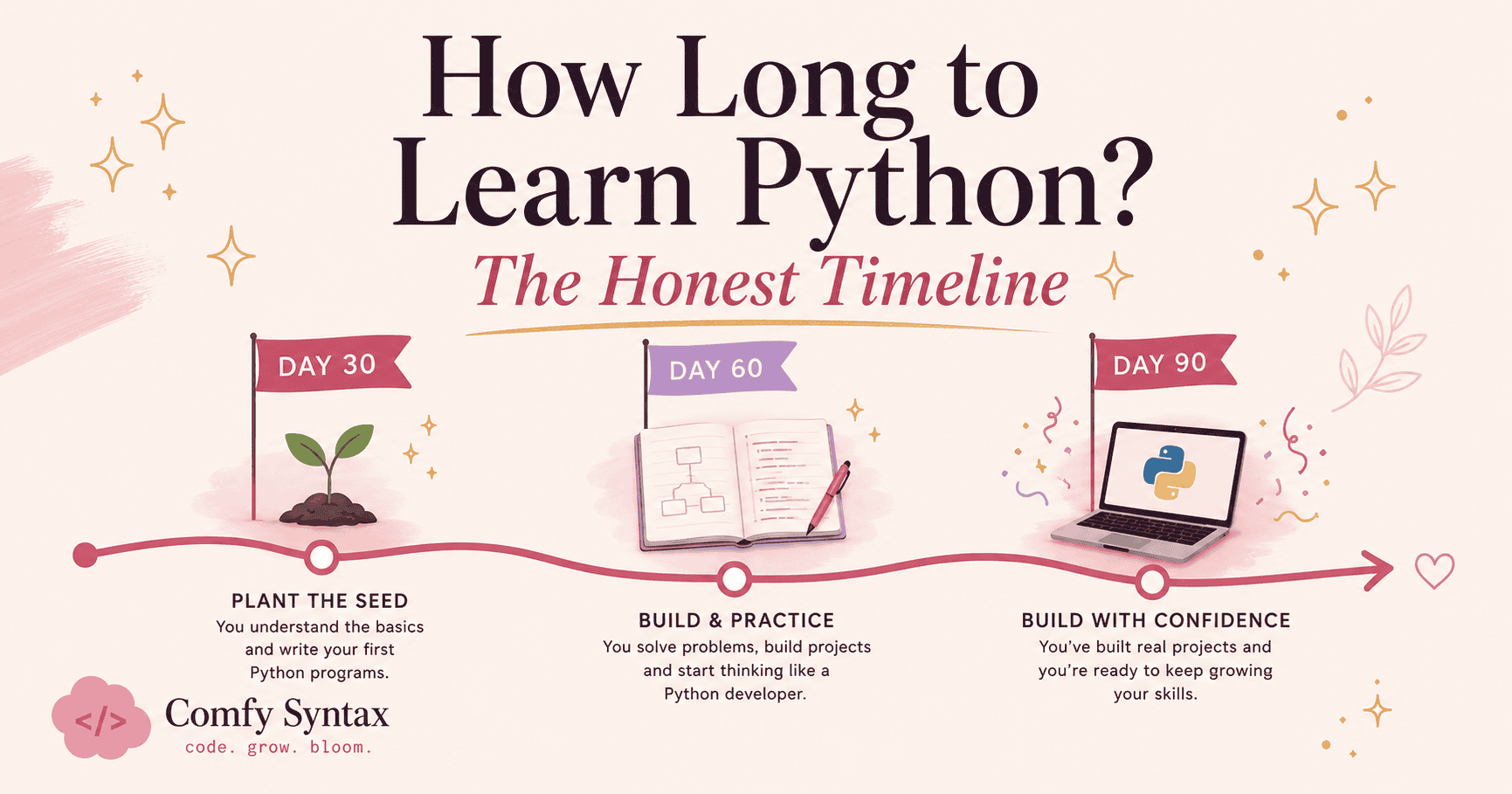
How Long Does It Take to Learn Python? An Honest Timeline for Beginners
Let’s answer the question before anything else, because you deserve a straight answer: with 30–60 minutes of practice most days, a complete beginner gets comfortable with Python fundamentals in about 8 to 12 weeks. Roughly 90 days. Not seven days, whatever that YouTube thumbnail promised — and not seven years either.
But “learn Python” means different things to different people, so let’s break the honest timeline down properly.
| 🐍 Why this matters: Wrong expectations are the #1 reason beginners quit. If you expect fluency in a week, day eight feels like failure. If you know the real shape of the journey, day eight feels exactly like it should: early. |
First: What Does “Learning Python” Even Mean?
There are three very different finish lines, and people mix them up constantly:
- Level 1 — The Basics (roughly 90 days). Variables, loops, conditionals, functions, lists — and small programs you built yourself. This is what this article is about.
- Level 2 — Comfortable (6–12 months). Building multi-file projects, reading other people’s code, using libraries confidently.
- Level 3 — Job-ready (12–24 months, part-time). A portfolio, a specialism (web, data, automation), and interview confidence.
Every level is built out of the first one. Nail the basics in 90 days and everything after moves faster.
The 90-Day Timeline, Honestly
Days 1–30: Foundations (the “oh, I can actually do this” month)
You’ll install Python, write your first programs, and learn variables, data types, input and output, and simple conditionals. Expect small wins and small errors daily. By day 30 you can write a program that asks questions and responds — which is genuinely more than most people who “want to learn coding” ever do.
Days 31–60: Practice & Patterns (the messy middle)
Loops, lists, functions — and the honest truth: this is where motivation dips. Week five or six is where most people quit, not because it got too hard, but because the novelty wore off before the habit formed. This is the month where structure and small daily practice matter more than enthusiasm.
| 📌 Remember: Consistency beats intensity. Thirty focused minutes a day beats a five-hour Sunday marathon — your brain consolidates code between sessions, not during them. |
Days 61–90: Building (the payoff month)
You combine everything into real small projects — a quiz game, a to-do list, a file-writing journal. Errors stop feeling like emergencies and start feeling like clues. By day 90 you’re not “done” — nobody ever is — but you’re a person who codes.
What Actually Changes Your Timeline
- Checking your work — practising with answer keys means mistakes get corrected instead of rehearsed.
- Practising vs watching — hands on keyboard learns 5× faster than eyes on videos.
- Frequency — 5–6 short sessions a week beats 1–2 long ones.
- Structure — a plan that tells you exactly what today’s 30 minutes covers removes the “what should I even study?” friction that kills momentum.
- Error support — beginners lose whole evenings to one error. Having fixes on hand can save you weeks across the journey.
A Realistic Weekly Rhythm
- Mon–Fri: 30–45 minutes — one concept + one small exercise.
- Saturday: 60–90 minutes — a mini project or catching up.
- Sunday: rest, or 15 minutes of flashcard review. Rest is part of the plan, not a betrayal of it.
Key Takeaways
- Python basics take a realistic 8–12 weeks at 30–60 minutes a day.
- “Learning Python” has levels — basics (≈90 days), comfortable (6–12 months), job-ready (1–2 years part-time).
- The danger zone is weeks 5–6, when novelty fades before habit forms.
- Consistency, hands-on practice, and structure shorten the journey more than talent does.
- By day 90 you won’t be finished — you’ll be someone who codes. That’s the real milestone.
Common Beginner Mistakes
- Believing “learn Python in a week” content, then feeling broken when it doesn’t happen.
- Marathon studying on weekends only — knowledge evaporates without frequent repetition.
- Restarting from lesson one every time motivation returns, instead of continuing where they left off.
- Measuring progress by videos watched instead of programs written.
Next Steps
- Block 30 minutes in your calendar for tomorrow. Day 1 of 90 starts with a calendar entry, not a mood.
- Read next: How to Remember Python Syntax (The Active Recall Method) — the study technique that makes each of the 90 days stick. How to Remember Python Syntax (The Active Recall Method)
Ninety days from now, you’ll either be someone who kept meaning to start — or someone who writes Python. Same ninety days either way. 🌸
The version of you at day 90 is built by the tiny, unremarkable thirty-minute sessions in between — and The Complete Path makes sure not one of them is wasted wondering what to study, or stuck on an error you can’t name.