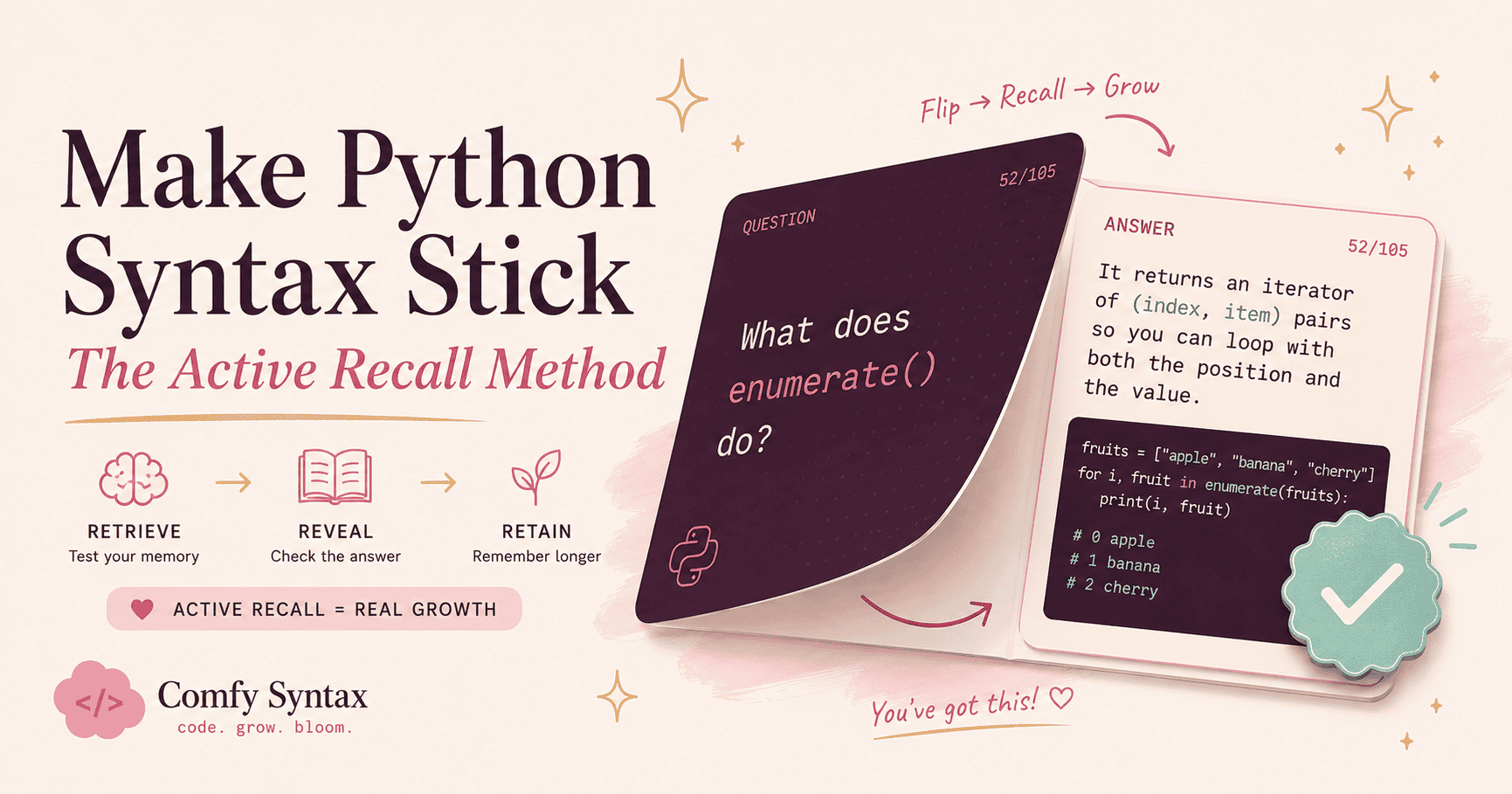
How to Remember Python Syntax (The Active Recall Method)
You watched the tutorial. You understood every word. Two days later you open a blank file and… how does a for loop start again? If this is you, nothing is wrong with your memory — something is wrong with your study method. And it has a fix with decades of research behind it.
| 🐍 Why this matters: Re-reading and re-watching create the “illusion of knowing” — the material feels familiar, so your brain files it as learned. But familiarity is not recall. Recall is what you need at the blank file, and recall is a muscle you train separately. |
Why You Forget (It’s Not You)
Your brain is ruthlessly practical: it keeps what you retrieve and quietly discards what you merely see. Watching a loop being written is seeing. Writing a loop from memory is retrieving. Only the second one tells your brain “we use this — keep it.”
This is why you can watch the same tutorial three times and still blank. Each rewatch feels productive and changes almost nothing.
💻 A recall rep looks like this:
# Question: loop through a list WITH the index
# (write your answer before scrolling... typed, not imagined)

for i, item in enumerate(my_list):
    print(i, item)
Add Spaced Repetition (The Multiplier)
Memories fade on a schedule, so review on a schedule that catches them right before they fade: after 1 day, then 3 days, then a week, then two weeks. Each successful recall at the edge of forgetting roughly doubles how long the memory lasts. Ten minutes of well-timed review beats an hour of cramming — and it’s calmer, too.
| 📌 Remember: The slight struggle to remember IS the workout. If review feels effortless, the card came too soon. If it feels like gentle straining — perfect, that’s the memory being rebuilt stronger. |
Three Rules That Make It Work for Code
- Shuffle categories. Mixing basics, loops, and functions in one session (interleaving) feels harder and works better than drilling one topic to death.
- Type, don’t recite. Syntax lives partly in your fingers. Saying “for i in range…” out loud is not the same as typing the colons and brackets.
- Small cards, one concept each. “What does .append() do?” — yes. “Explain lists” — too big to recall, too vague to check.
The Flashcard Method, Step by Step
- Ten minutes a day. Attach it to an existing habit — with your morning coffee, or as your “closing ritual” after each study session.
- Pick 10–15 cards for today’s session — a mix of new and due-for-review.
- Read the question. Type the answer from memory. Then flip.
- Right → it comes back in a few days. Wrong → it comes back tomorrow. That’s the entire system.
📖 Skip the card-making homework: The Comfy Syntax Python Flashcards give you 117 ready-made cards across 7 categories — basics, data types, Objects, loops, functions, APIs & Files, PCAP Prep, built-in magic and debugging. The Interactive Flashcards edition flips, shuffles and tracks your progress in any browser; the Printable Flashcards deck is for screen-free study on the couch.
Key Takeaways
- Ten minutes of daily recall beats an hour of re-watching.
- Forgetting syntax is a method problem, not a memory problem.
- Active recall = produce the answer from memory first, check second.
- Spaced repetition times your reviews to catch memories right before they fade.
- Type your answers — syntax memory is partly muscle memory.
Common Beginner Mistakes
- Cramming before “testing yourself” once — one recall session can’t compete with six spaced ones.
- Re-watching tutorials as “revision” — familiarity masquerading as knowledge.
- Highlighting and note-copying — pleasant, colourful, and nearly useless for recall.
- Flipping the card too fast — give yourself the ten uncomfortable seconds of trying first.
Next Steps
- Tonight, write down three Python questions from memory (e.g. “how do I get a list’s length?”). Tomorrow with coffee, answer them typed, from memory. You’ve started.
- Pair recall with a realistic plan: How Long Does It Take to Learn Python? → How Long Does It Take to Learn Python? An Honest Timeline for Beginners
- Grab the ready-made deck and let the system do the scheduling: 117 cards, 7 categories.
The coders you admire don’t have better memories than you — they’ve just retrieved the same syntax hundreds of times until it lives in their fingers. 🌸 Ten minutes a day, cards shuffled, answers typed. In a month, the blank file stops being scary, because the syntax shows up when you call it.