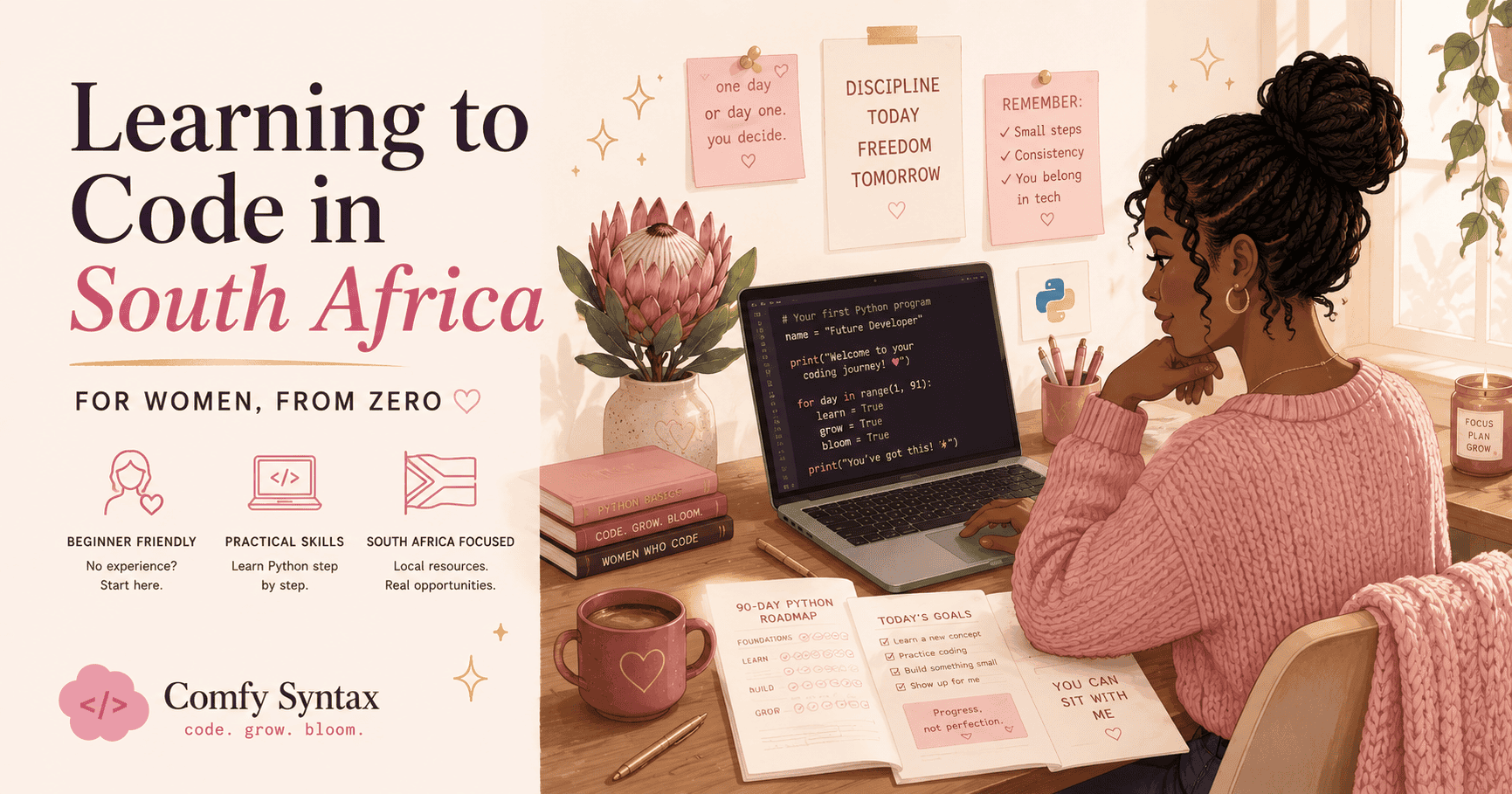
Learning to Code in South Africa: A Beginner’s Guide for Women
Maybe you’ve watched the tech industry grow from the outside and wondered if there’s space in it for you. Maybe you’re a student, a mom, a career changer, or someone whose job feels shakier every year. Here’s the honest answer up front: yes, there’s space for you — and you can start this week, from home, for less than the cost of a takeaway dinner.
This guide covers what the journey actually looks like from South Africa: what you need, what you don’t, what it costs in rand, and the first step that matters.
| 🐍 Why this matters: SA’s tech industry keeps growing, remote work has opened international salaries to local talent, and skills increasingly beat degrees on junior CVs. The door is more open than it has ever been — it just helps enormously to have someone explain where the handle is. |
The Honest Picture of Tech in South Africa
Software skills are in demand across Joburg, Cape Town and Durban — and remote roles mean your employer doesn’t have to share your city, or even your continent. Entry isn’t instant: junior roles are competitive, and you’ll need real skills plus a small portfolio. But the path is genuinely learnable, and it does not require a computer science degree. What employers increasingly want to see is simple: can you actually build things?
Why Python Is the Right First Language
- It reads almost like English — print(“Hello”) does exactly what it looks like.
- It’s everywhere: web development, data analysis, automation, AI. Learning Python doesn’t lock you into one career door; it opens several.
- The beginner ecosystem is enormous — more gentle resources exist for Python than any other language.
What You DON’T Need (Read This Twice)
- A computer science degree — portfolios and skills carry junior hiring more every year.
- An expensive laptop — anything that can run a browser can run beginner Python. Second-hand is fine.
- To be a “maths person” — beginner coding uses less maths than your monthly budget does.
- To be 22 — career changers bring focus and life skills that 22-year-olds are still developing.
- Permission — from anyone.
What You DO Need
- A plan — the #1 beginner killer isn’t difficulty, it’s “what should I even study today?” A structured, day-by-day path removes that decision fatigue completely.
- Consistency — 30 minutes most days beats heroic weekends. (Here’s the honest timeline → How Long Does It Take to Learn Python? An Honest Timeline for Beginners
- Practice with feedback — exercises with answer keys, so mistakes get corrected instead of rehearsed.
- A little community — other women on the same path make the hard weeks lighter. Look for SA communities like GirlCode and local women-in-tech meetups, and follow along on Instagram and Pinterest where the study-motivation crowd lives.
The SA-Specific Realities (And How to Work With Them)
- Budget: you can genuinely start for under R100. Coding is one of the cheapest career skills to learn — the expensive part is only ever the time.
- Data costs: choose learning resources you download once and keep, instead of streaming hours of video every session.
- Load shedding: printable study materials are stage-8-proof. Flashcards and workbooks don’t need Eskom’s cooperation.
Your First 90 Days, Mapped
- Days 1–30: Foundations — install Python, learn variables, input/output, and conditionals with tiny daily wins.
- Days 31–60: Practice — loops, lists and functions, drilled with exercises and flashcards until they stick.
- Days 61–90: Build — small real projects (a budget calculator in rand, a quiz game, a journal logger) that become your first portfolio pieces.
📖 Start for less than a takeaway: The Starter Pack (R99) is the whole first chapter of this journey in one download: the 90-Day Python Guide, the Practice Workbook, printable flashcards and a cheat sheet — beginner-safe, printable, load-shedding-proof, and paid in rand via PayFast.
Key Takeaways
- There is real, growing space for women in SA tech — and remote work widens it further.
- Python is the friendliest, most versatile first language.
- You don’t need a degree, an expensive laptop, or maths genius. You need a plan, consistency, and practice.
- Downloadable, printable resources fit SA realities: data costs and load shedding.
- You can start this week for under R100.
Common Beginner Mistakes
- Waiting to feel ready — readiness is built by starting, never before.
- Collecting free resources endlessly instead of following one path to the end.
- Studying in secret and quitting in silence — tell one person, join one community.
- Comparing your day 10 to someone else’s year 5 on LinkedIn.
Next Steps
- Take the actual first step: the Starter Pack has your first 90 days planned, printed and ready.
- Decide your daily 30 minutes — before work, lunch break, after the kids sleep — and put it in your calendar for tomorrow.
- Read: How Long Does It Take to Learn Python? for the full honest timeline. How Long Does It Take to Learn Python? An Honest Timeline for Beginners
Somewhere in South Africa right now, a woman with the same doubts you have is on day 60 of her plan, quietly building a quiz game while the neighbourhood waits out load shedding by candlelight. 🌸 The only difference between you and her is that she started. Where women come to code, grow and bloom — that’s not just a tagline. It’s an invitation.