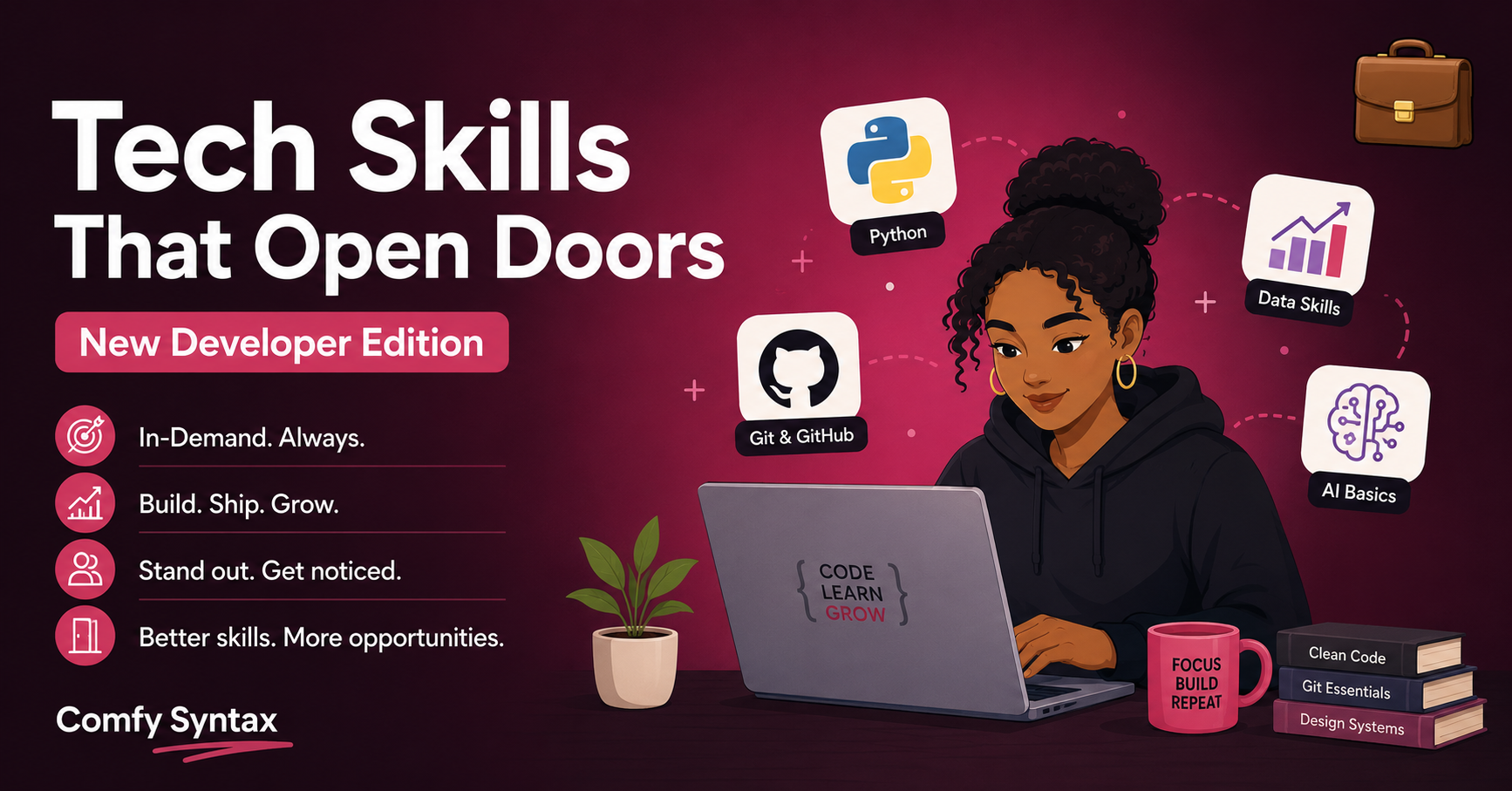
Tech Skills That Help You Stand Out as a New Developer
The Question Every Beginner Asks
“What skills do I actually need to get a tech job?” It’s the question every new developer asks — and the honest answer is: fewer than you think, but deeper than most tutorials teach you.
The South African tech job market is growing fast. Companies are hiring junior developers, data analysts, QA testers, and automation specialists — and many of them care more about what you can build than where you studied.
Here’s what will actually make you stand out as a new developer — the skills hiring managers notice.
| 🌍 SA context: Junior Python developers in South Africa earn between R25,000 and R35,000 per month. Data analysts and automation specialists can earn more. These skills are your ticket in. |
1. Python — The Easiest First Language With Real Career Value
Python is consistently ranked as one of the most in-demand programming languages in the world — and in South Africa, it’s used heavily in data science, automation, web development, and AI.
For beginners, Python is the best first language because:
- It reads almost like plain English — lower barrier to entry
- It’s used in industries that are actually hiring: finance, healthcare, retail, and more
- It’s the language most data science and AI roles require
- The community is massive — help is always available
You don’t need to know everything about Python to get your first opportunity. You need to know it well enough to solve real problems — and that’s a much smaller mountain than it sounds.
2. Git and Version Control — The Skill Employers Assume You Have
Git is how developers save and share their work. It’s how teams collaborate on code without overwriting each other’s changes. And it’s listed in almost every developer job posting — often without even being mentioned as a “requirement” because hiring managers assume you already know it.
What you actually need to know to start:
- How to initialise a Git repository
- How to commit changes (think of it as saving with a description)
- How to push your code to GitHub so others (and employers) can see it
- How to create branches and merge them
GitHub is also your developer CV. When an employer Googles you and finds a GitHub profile with real projects and consistent commits, that speaks louder than most cover letters.
3. A Portfolio With Real Projects — Not Just Tutorials
This is the single most underrated career move a beginner can make. A portfolio is proof that you can actually build things — not just follow along with a tutorial.
You don’t need ten projects. You need two or three that are: yours (not clones of tutorial projects), functional (they actually run), and explained (a README that says what the project does and why you built it).
Portfolio project ideas that stand out in the SA market:
- A Python budget tracker using ZAR
- A web scraper that pulls price data from Takealot or Checkers
- A data visualisation of South African employment or crime statistics
- A simple chatbot built using the OpenAI or Claude API
- A CSV data cleaner for a dataset you found on Statistics South Africa
| 💡 Portfolio tip: Push every project to GitHub with a clear README. Even messy beginner projects show initiative and honesty — much better than an empty profile. |
4. Problem-Solving Confidence — Googling Counts
Here’s a secret the tech industry doesn’t advertise loudly: professional developers Google things constantly. Stack Overflow, documentation, GitHub issues, AI assistants — they’re all on the table.
The skill isn’t memorising syntax. The skill is knowing how to find answers, evaluate them, and apply them. That’s what separates someone who can code from someone who gets stuck every five minutes.
How to build this skill:
- Practice debugging your own errors before looking them up — try to read what Python is actually telling you
- When you Google a solution, understand why it works before copying it
- Learn to use AI tools like ChatGPT or Claude to explain errors and suggest approaches — this is now a core developer skill
- Keep an error journal so you stop making the same mistakes twice
5. Basic Data Literacy — Even If You’re Not Going Into Data Science
Data is everywhere. Even if you’re not aiming to be a data scientist, being comfortable with data — reading CSV files, doing basic analysis, visualising results — will make you more useful in almost any tech role.
Python makes this accessible with libraries like pandas and matplotlib. You don’t need to be an expert. You need to know enough to be helpful.
Start here:
- Learn how to read and write CSV files in Python
- Understand what pandas is and why it’s used
- Be able to describe what a dataset contains and spot obvious errors
- Create at least one simple chart or visualisation from real data
6. AI Literacy — The Skill That Will Separate the Next Generation
This one is coming fast. Companies are increasingly looking for developers who know how to work with AI — not just use ChatGPT to write their emails, but actually integrate AI into applications.
In South Africa, this is still rare. Most bootcamps and universities aren’t teaching it yet. That means learning it now puts you ahead of the curve.
What this looks like practically:
- Understanding how to call the OpenAI or Claude API from Python
- Building a simple AI-powered application — even a basic chatbot counts
- Knowing the ethical limitations of AI (what it can’t reliably do)
- Using AI tools to accelerate your own coding and learning — smartly
This is exactly why Python Decoded includes a full AI integration section. The students who complete it are ahead of most junior developers coming out of formal programmes right now.
Key Takeaways
- Python is the most valuable first language for career purposes in SA — but depth matters more than breadth.
- GitHub is your portfolio — and employers will look at it.
- Two or three real projects beat fifty tutorials.
- Problem-solving confidence (including Googling and using AI) is a core skill, not a cheat.
- AI literacy is the emerging differentiator — learning it now puts you ahead.
Common Beginner Mistakes
- Waiting until they feel “ready” to apply — readiness comes from doing, not from more studying.
- Having a GitHub profile with zero or private repositories — employers can’t see effort they can’t see.
- Only learning syntax without building anything — knowing the theory without the practice doesn’t translate to interviews.
- Ignoring soft skills — communication, asking good questions, and following through matter in tech teams.
Next Steps
- Open a GitHub account today if you don’t have one yet — free, takes five minutes.
- Pick one small project from the list above and commit to building it this week.
- Read: Python Variables Explained Simply — a great place to start if you’re still building your Python foundation.
- If you want a roadmap that takes you from beginner to job-ready in 90–111 days — including a portfolio project in every phase and a dedicated “Get Hired” section — Premium Study Pack was built for exactly this.
The South African tech industry is growing — and it needs people exactly like you. You don’t need a degree. You need the right skills, a portfolio that shows what you can do, and a structured path to get there. Premium Study Pack is that path: 7 phases, 12 real projects, SA job boards and salary data, and a full section on getting hired.