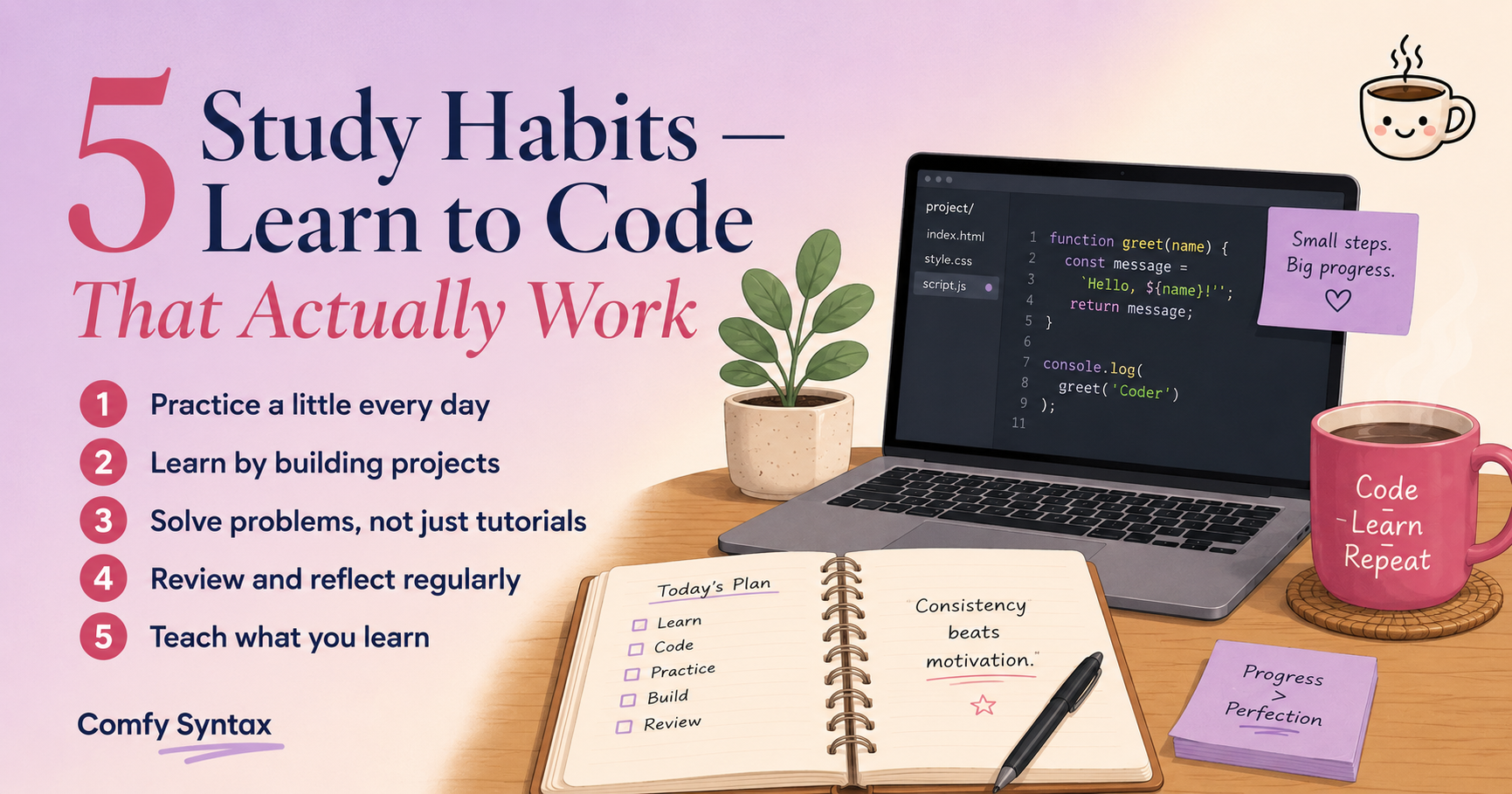
5 Study Habits That Will Actually Help You Learn to Code
Why Most Beginners Quit (And How to Not Be One of Them)
Learning to code is one of the best decisions you can make — but it’s also one of the easiest things to give up on. Not because coding is too hard. Because most beginners study the wrong way.
They binge-watch tutorials for six hours on Saturday, do nothing for two weeks, then wonder why nothing’s sticking. Sound familiar?
Here’s the truth: how to study coding effectively matters just as much as what you study. These five habits are the difference between the people who make it and the people who give up in week three.
| 💡 Quick note: Coding is a journey, not a race. You don’t need to study for hours every day — you need to study consistently. Even 30 focused minutes beats a six-hour binge session every time. |
Habit 1: Code Every Single Day — Even for Just 30 Minutes
Your brain builds new pathways through repetition. Missing a day isn’t the problem. Missing several days in a row is — because you start forgetting the syntax you just learned and losing the momentum you built.
Set a non-negotiable minimum. Thirty minutes. Even on hard days. Even when you’re tired.
How to actually stick to this:
- Pick a specific time — lunch break, 7am before work, after the kids are in bed.
- Set a phone alarm called “Code time” so you can’t pretend you forgot.
- Keep your laptop (or your study materials) visible — out of sight, out of mind is real.
- Track your streak in your Coding Journal so you can see your progress building up.
Even on days when you only have 20 minutes, open your editor and write something. Anything. Consistency beats intensity every time.
Habit 2: Use Active Recall — Stop Re-Reading, Start Testing Yourself
Here’s what most beginners do: read a chapter, highlight some stuff, re-read it. Feels productive. But passive reading is one of the least effective ways to actually learn.
Active recall means closing your notes and trying to remember what you just learned. It’s harder — and that’s the point. The struggle is what makes it stick.
Easy ways to do active recall while learning Python:
- After reading about a concept, close the notes and try to write the code from memory.
- Quiz yourself: “What does len() do? What’s the difference between a list and a tuple?”
- Use flashcards — explain what each term means before flipping to check.
- Teach it to someone (or a rubber duck on your desk — seriously, it works).
| 💡 Quick note: Coding is a journey, not a race. You don’t need to study for hours every day — you need to study consistently. Even 30 focused minutes beats a six-hour binge session every time. |
Habit 3: Build Real Things, Not Just Tutorials
Tutorial projects are great for learning syntax. But at some point, you need to close the tutorial and build something yourself.
This is where real learning happens. You hit errors you’ve never seen. You google things. You figure it out. And you remember it — because you solved it yourself.
Simple project ideas to try as a beginner:
- A budget tracker in Python that uses your own rand amounts
- A to-do list app that saves tasks to a file
- A quiz game that tests you on Python concepts
- A daily mood logger that saves your entries to a CSV
Start small. Build messy. It doesn’t have to be perfect — it just has to be yours.
Habit 4: Track What You Learn and What You’re Struggling With
This habit is underrated and underused. Most beginners either track nothing (and lose track of what they’ve covered) or they highlight everything (and retain nothing).
Tracking your learning in a structured journal does three things: it shows you how far you’ve come, it surfaces the gaps you need to revisit, and it keeps you honest about whether you’re actually making progress.
What to track:
- What concept did you study today?
- What’s still confusing?
- What errors did you get — and how did you fix them?
- What do you want to review tomorrow?
| 📓 Made for this: The Comfy Syntax Coding Journal has a 13-week structure built for exactly this — daily study logs, weekly reflections, error journals, and habit trackers. |
Habit 5: Embrace the Error — It’s Not Failure, It’s Feedback
One of the biggest mindset shifts you need to make as a beginner coder is this: errors are not the enemy. Errors are your teacher.
Every experienced developer — every single one — spends a significant chunk of their day reading error messages, debugging, and figuring out what went wrong. It’s not a sign that you’re bad at this. It’s literally the job.
How to actually learn from errors:
- Read the error message fully before panicking. Python usually tells you exactly what went wrong and on which line.
- Search the exact error message on Google. Stack Overflow is your friend.
- Write down the error and what caused it in your error journal — you’ll see patterns.
- Ask AI for help: “What does this error mean and how do I fix it?” is a perfectly valid prompt.
The developers who grow fastest aren’t the ones who write perfect code. They’re the ones who debug confidently.
Key Takeaways
- Thirty minutes of daily coding beats a six-hour weekend binge.
- Active recall (testing yourself) is far more effective than passive re-reading.
- Building your own small projects — however messy — is where real learning happens.
- Track your progress and your errors so you can see growth and spot gaps.
- Errors are feedback, not failure. Read them, google them, learn from them.
Common Beginner Mistakes
- Tutorial hopping — jumping from one course to another without finishing anything. Pick one structured path and stick with it.
- Studying in long sporadic bursts instead of short daily sessions.
- Skipping the exercises — watching code being written is not the same as writing it yourself.
- Giving up after the first error. Errors are normal. They’re universal. They never fully stop.
Next Steps
- Block out a 30-minute daily coding slot in your calendar right now — yes, now.
- Start a simple study log — even a notebook will do to start.
- Read our next post: Tech Skills That Help You Stand Out as a New Developer.
- If you want a structured system for everything (study guide + journal + flashcards), take a look at the Comfy Syntax Premium Study Pack — it’s designed to make consistent studying effortless.
You’re not behind. You’re not too old. You’re not “not a tech person.” You just need a system that works — and now you have one. The Comfy Syntax Coding Journal was designed with exactly these habits in mind: 13 weeks of daily planners, error logs, and weekly reflections to keep you on track, day by day.